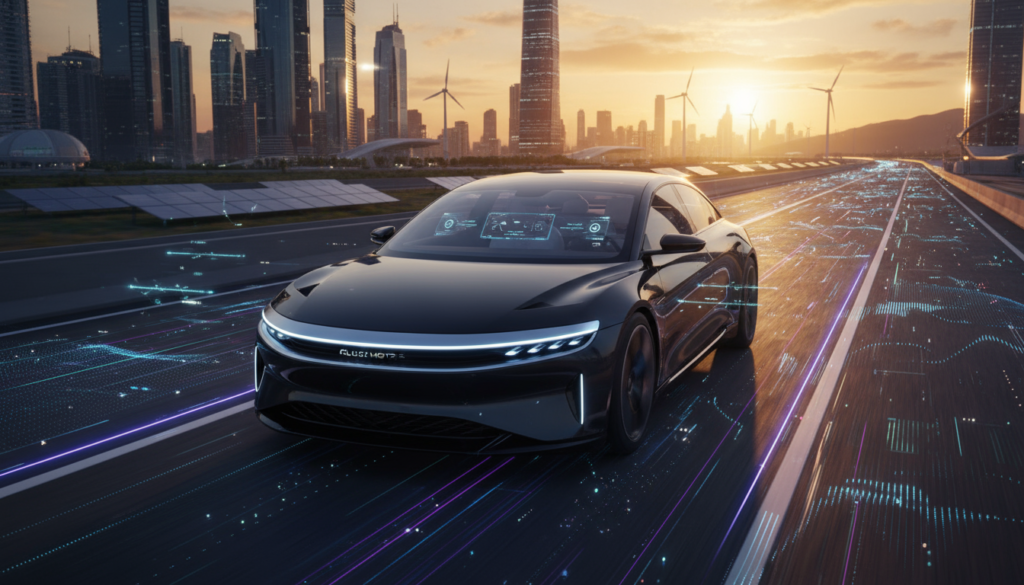
The electric vehicle revolution once felt like a one-company race.
For years, Tesla was the undisputed king of EVs. It changed how Americans viewed electric cars, turned EVs into status symbols, and pushed legacy automakers into panic mode. People didn’t just buy Teslas — they bought into a vision of the future.
But something unexpected happened.
While the world was busy watching Tesla dominate headlines, a quieter company from China was building an empire behind the scenes. That company was BYD.
Today, BYD is no longer “the company chasing Tesla.” In many ways, it has already surpassed it. BYD now sells more electrified vehicles globally, expands faster into international markets, controls more of its supply chain, and is becoming one of the most powerful forces in the future of transportation.
And for American readers, this story matters more than ever.
Because the rise of BYD is not just about cars. It’s about technology, global manufacturing, battery innovation, affordability, geopolitics, and the future of the entire EV industry.
The question is no longer whether BYD is a serious threat to Tesla.
The real question is: how did BYD overtake Tesla to rule the EV world?
The EV World Tesla Created
To understand BYD’s rise, you first have to understand Tesla’s impact.
When Tesla launched the Model S, EVs stopped looking boring. Suddenly, electric cars became fast, premium, futuristic, and desirable.
Tesla achieved what many thought was impossible:
It made EVs cool
It forced traditional automakers to react
It accelerated battery innovation
It built one of the world’s strongest automotive brands
For nearly a decade, Tesla operated like a tech company disguised as a carmaker. Its software-first mindset, over-the-air updates, Supercharger network, and aggressive innovation strategy gave it a massive lead.
Meanwhile, many competitors struggled to keep up.
But while Tesla focused heavily on premium vehicles and global hype, BYD focused on something else entirely: scale, efficiency, and affordability.
That difference changed everything.
What Is BYD and Why Was Nobody Paying Attention?
BYD started long before most Americans had ever heard of it.
Founded in 1995, BYD originally built rechargeable batteries. In fact, the company became one of the world’s largest battery manufacturers before it seriously entered the car business.
That battery expertise would later become BYD’s biggest weapon.
Unlike many automakers that rely heavily on suppliers, BYD learned how to control almost every part of the production process internally. Batteries, semiconductors, electric motors, software systems — BYD invested deeply in vertical integration years before it became a trendy business strategy.
For a long time, Western consumers ignored BYD because its vehicles weren’t competing directly in the United States or Europe at the same scale as Tesla.
But inside China — the world’s largest EV market — BYD was quietly becoming unstoppable.
And once it mastered China, global expansion became the next logical step.
China Became the Perfect EV Battlefield
One of the biggest reasons BYD overtook Tesla is simple:
China moved faster than almost anyone expected.
The Chinese government aggressively supported electric vehicle adoption through subsidies, infrastructure investment, manufacturing incentives, and industrial policy. Cities pushed EV adoption to reduce pollution and dependence on imported oil.
At the same time, Chinese consumers embraced EV technology rapidly.
That created the perfect environment for companies like BYD to scale at lightning speed.
Tesla entered China and achieved major success with its Shanghai Gigafactory. But BYD had one enormous advantage: it already deeply understood the local market.
BYD knew what Chinese consumers wanted:
Affordable EVs
Reliable battery performance
Practical designs
Technology-rich interiors
Competitive pricing
Instead of focusing only on premium buyers, BYD attacked nearly every market segment.
That strategy helped it reach millions more consumers.
BYD’s Biggest Secret: It Controls the Battery Game
If Tesla made the modern EV famous, BYD mastered the economics behind it.
And in the EV world, batteries are everything.
Battery costs determine:
Vehicle pricing
Profit margins
Driving range
Production scalability
Long-term competitiveness
This is where BYD became incredibly dangerous.
The Blade Battery Changed the Conversation
BYD introduced its famous Blade Battery, which quickly became one of the company’s defining innovations.
The Blade Battery uses lithium iron phosphate (LFP) chemistry, which offers several advantages:
Lower cost
Improved safety
Longer lifespan
Reduced fire risk
Less dependence on expensive materials like nickel and cobalt
At first, some critics viewed LFP batteries as inferior because they typically offered lower energy density compared to premium lithium-ion alternatives.
But BYD proved something important:
Most consumers care more about affordability, safety, and reliability than maximum performance numbers.
That realization helped BYD scale much faster.
Ironically, even Tesla eventually began adopting LFP battery technology for some of its vehicles.
That alone showed how much the industry was shifting.
Tesla Focused on Innovation. BYD Focused on Domination.
Tesla and BYD approached the EV market very differently.
Tesla built aspiration.
BYD built infrastructure.
Tesla focused heavily on:
Brand identity
Software innovation
Autonomous driving ambitions
Premium EV experiences
BYD focused on:
Manufacturing efficiency
Supply chain control
Affordable pricing
Mass-market adoption
In many ways, BYD behaved more like a traditional industrial powerhouse combined with modern EV technology.
And that combination became extremely effective during global supply chain disruptions.
When other automakers struggled with shortages, BYD often maintained stronger production stability because it controlled so much internally.
That operational strength helped BYD expand aggressively while competitors slowed down.
Affordable EVs Became BYD’s Superpower
One of Tesla’s biggest challenges is affordability.
Even though Tesla reduced prices multiple times, many Americans still see Teslas as expensive vehicles. Insurance costs, financing rates, and higher upfront pricing continue to limit mass adoption.
BYD attacked the market from the opposite direction.
The company focused heavily on lower-cost EVs that ordinary consumers could realistically afford.
That strategy unlocked enormous demand.
For many global buyers, BYD vehicles represented:
Better value
More accessible pricing
Competitive technology
Practical daily usability
In developing markets especially, affordability matters more than luxury branding.
This is one reason BYD expanded so rapidly across:
Southeast Asia
Latin America
Europe
Australia
Middle Eastern markets
Tesla remained strong in premium segments, but BYD started winning the broader volume war.
And in the automotive industry, volume often decides long-term dominance.
BYD’s Expansion Beyond China Is Accelerating Fast
For years, critics argued that BYD’s success only mattered inside China.
That argument is becoming weaker every year.
BYD is now aggressively expanding internationally.
The company has entered or expanded in:
Brazil
Mexico
Thailand
Germany
Australia
Japan
United Kingdom markets
Its electric buses are already operating in multiple countries, including parts of the United States.
This matters because global EV leadership is no longer just about one country. It’s about manufacturing scale, battery supply chains, and worldwide reach.
BYD understands this clearly.
Instead of relying only on exports, the company is increasingly investing in overseas manufacturing and partnerships to strengthen its global footprint.
Why Tesla Still Matters — A Lot
Even with BYD’s rise, declaring Tesla “finished” would be a huge mistake.
Tesla remains one of the most influential automakers on Earth.
Tesla still leads in several critical areas:
Charging infrastructure
Software ecosystem
Brand loyalty
Autonomous driving ambitions
Energy ecosystem integration
For many consumers, Tesla remains the aspirational EV brand.
Its influence on automotive design, manufacturing innovation, and public EV adoption cannot be overstated.
But the EV market has matured.
This is no longer a winner-takes-all race.
The global EV industry is becoming more competitive, more regionalized, and more price-sensitive.
And that environment benefits companies like BYD tremendously.
American Consumers Are Watching Closely
Most Americans still don’t fully realize how massive BYD has become.
That could change quickly.
Political tensions and trade policies currently limit BYD’s direct expansion into the United States passenger vehicle market. Tariffs and national security concerns remain major barriers.
But even without dominating U.S. roads yet, BYD’s influence is already affecting American consumers indirectly.
How?
Because BYD’s rapid growth pressures the entire EV industry to:
Lower prices
Improve battery technology
Increase production efficiency
Accelerate innovation
That competitive pressure benefits buyers everywhere.
If BYD continues scaling globally, American automakers may face enormous pressure to reduce EV prices faster than expected.
The EV Price War Changed Everything
One of the biggest turning points in the industry was the EV price war.
Tesla began aggressively cutting prices to maintain growth and competitiveness.
Soon, other automakers followed.
But BYD had an advantage during this battle: lower production costs.
Because BYD controls so much of its manufacturing ecosystem internally, it can often survive lower-margin pricing more effectively than competitors.
This became especially important as EV demand growth started slowing in some markets.
Consumers suddenly became more price-conscious.
That favored BYD’s strategy perfectly.
In many regions, buyers started asking: “Why spend significantly more when a cheaper EV offers most of the same daily benefits?”
That question continues reshaping the market.
Battery Technology Is the New Oil
The future of the automotive industry may depend less on engines and more on battery dominance.
And BYD understands this better than almost anyone.
The company’s roots in battery manufacturing gave it a foundation many automakers still lack.
In the future, battery leadership could determine:
Which companies dominate EV sales
Which nations control supply chains
Which automakers remain profitable
Which technologies become industry standards
This is why BYD’s rise feels bigger than just another car company success story.
It represents a shift in industrial power.
The Future of Tesla vs BYD
The rivalry between Tesla and BYD may define the next decade of transportation.
But the competition isn’t as simple as many headlines make it seem.
Tesla still dominates global EV mindshare.
BYD dominates manufacturing scale and affordability.
Tesla behaves like a disruptive technology company.
BYD behaves like an industrial machine optimized for mass production.
Both approaches are powerful.
And both companies may continue growing for years.
But one thing is becoming increasingly clear:
The era where Tesla stood alone at the top of the EV world is over.
The market has entered a new phase — and BYD is now one of the central forces shaping it.
What This Means for the Future of EVs
For consumers, the BYD vs Tesla battle is actually good news.
Competition usually drives:
Better vehicles
Faster innovation
Lower prices
Improved battery technology
Expanded charging infrastructure
The next generation of EVs will likely become:
More affordable
More reliable
Faster to charge
Better for long-distance travel
Easier for mainstream families to own
That’s exactly what the industry needs if electric vehicles are going to replace gasoline cars at scale.
And companies like BYD are helping accelerate that transition dramatically.
Practical Takeaways for American EV Buyers
If you’re an American consumer watching the EV market evolve, here are the biggest takeaways from BYD’s rise:
- EV prices will likely keep falling
Global competition is putting enormous pressure on automakers to reduce costs. - Battery innovation is moving incredibly fast
Expect safer, longer-lasting, and cheaper battery technologies over the next decade. - More affordable EVs are coming
The future of EV adoption depends on mass affordability, not just luxury vehicles. - Tesla is no longer the only EV powerhouse
Consumers now have more options than ever before. - The global EV race is just getting started
China, the United States, Europe, and emerging markets are all competing for leadership.
The Emotional Reality Behind BYD’s Rise
There’s something deeply symbolic about BYD overtaking Tesla in parts of the global EV race.
For years, Tesla represented the future almost by itself.
Now the future looks bigger, more competitive, and far less predictable.
That shift can feel exciting or uncomfortable depending on where you stand.
But one thing is undeniable:
The electric vehicle revolution is no longer a niche movement led by one visionary company.
It has become a global industrial transformation.
And BYD’s rise proves that the companies shaping the future may not always be the loudest ones in the room.
Sometimes, they’re the ones quietly building the foundation while everyone else watches the spotlight.
FAQs
Is BYD bigger than Tesla now?
In total electrified vehicle sales, BYD has surpassed Tesla in several global metrics. However, Tesla still remains stronger in brand recognition, software leadership, and profitability in many segments.
Why are BYD electric cars cheaper?
BYD benefits from strong vertical integration. The company manufactures many key components internally, including batteries and semiconductors, helping reduce production costs significantly.
Can BYD compete in the United States?
BYD currently faces trade barriers and political challenges in the U.S. passenger vehicle market. However, its global growth and battery technology continue influencing the broader EV industry worldwide.